



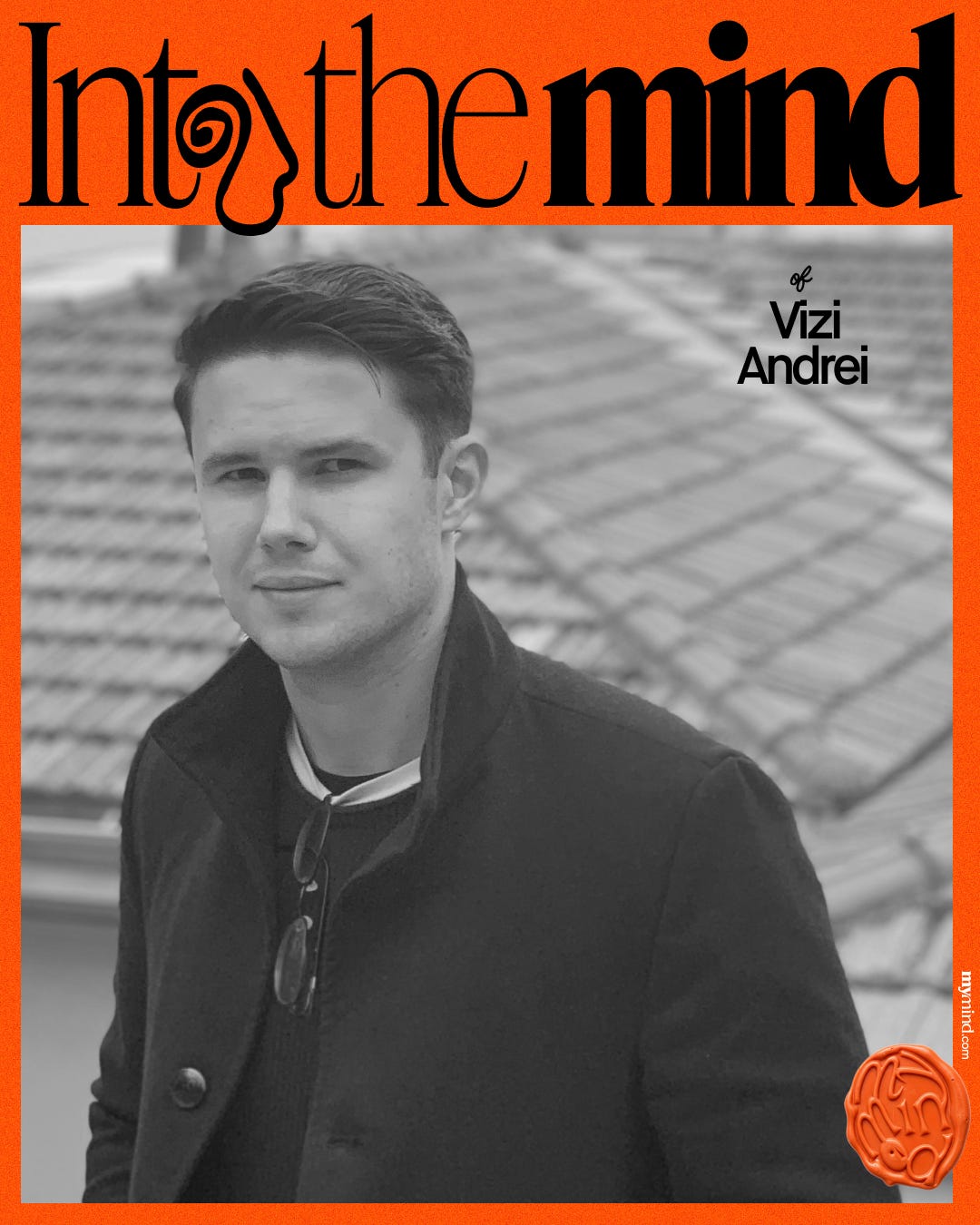
Vizi Andrei sees our modern world with a sort of optimistic skepticism. He notices the hustle, the pervasive anxiety, the loss of leisure and beauty, and asks why we’ve settled for it. On his Substack, The Sovereign Artist, he writes about how we might carve out a different kind of life. His values resound in his writing, which somehow both challenges and comforts at once. You’ll see what I mean in this interview.
What’s the best compliment you received recently?
I’m terrible at receiving compliments and, by extension, at remembering them. Not because I’m not sufficiently confident, not because I hate attention, not because I’m modest, but because I exercise my skepticism: are they being authentic or not? Thus it’s not only important what the compliment is but who casts upon me the burden of analyzing its veridicity.
The best compliment I’ve received — or at least the one I remember receiving lately — had to do with my writing. It came from Gergely Böszörményi Nagy, the founder of Brain Bar, who told me that my essays are “invigorating and gentle.” The word gentle carries a lot of nuance for me because he didn’t say “deep” or “profound” — easy things to say.
Gentle means noble, refined; it comes from the Old French gentil. I never particularly perceived my writing this way, but after receiving this compliment, I decided to pursue this quality intentionally and, indeed, to aim for gentleness in my writing. Many writers are profound, many are clever, some are funny, others are creative — but how many are gentle?
What’s the last thing you read?
“The Decline of Deviance,” this essay by Adam Mastroianni; a fascinating diagnosis of how society is becoming less weird, with people taking fewer (intellectual, creative, or artistic, but not only) risks in almost every sector and industry. His argument is that our obsession with safety is, to some extent, destroying culture. That’s my takeaway; he’s less radical, emphasizing both the positives and the negatives.
Sometimes I think about the “AI revolution” and how everyone blames AI for the proliferation of slop. But we already had slop everywhere around us. Think of everything from YouTube thumbnails, influencer trends, LinkedIn posts and novel covers to cars, housing and the logos of tech and fashion brands. AI didn’t revolutionize any of this; it simply made slop mass-manufacturable. It’s helping to same-ify writing, branding, design, art, and “human” expression in general.
I hope and I feel this phenomenon will have explosive consequences at some point, in the form of rebellion, and manifest as an incentive for many creative creatures to finally defy our anti-culture culture: to fully embrace looking for our weirdness, expressing our weirdness, and being a little crazy again.
What do you want to read next?
More poetry of any kind. I find poetry to be both the most nourishing and the most difficult genre to process because you need to enter a certain spiritual space, not simply an intellectual one. Thus, you need a ritual in order to read poetry, not merely “habits” or “routines.” You can’t simply read poetry every day mechanically: wake up at 7:00, have your coffee and then read three poems.
Reading poetry requires an ability to organically educate and cultivate a sense of serendipity which paradoxically visits you predictably often. Sometimes you read a great deal of poetry, sometimes only a little; but you keep returning to it every week, knowing when to read with intensity and when to approach it gently. This is what I’m struggling with, but it’s worth the challenge.
Some poets I like are Fernando Pessoa, Lucian Blaga or Thomas Wyatt.
Best gift you’ve ever given or received?
Probably a turntable and a few vinyl records that my wife gave me. It’s a very different experience from listening to music on YouTube. I always wanted to get one, but for some reason, I always postponed this purchase. My wife surprised me with this lovely gift, and I’m surprised by how much I enjoy it. Music in this context has a different texture and tension. There’s more lyricism and richness.
I’ve been listening to Hungarian and Romanian folk music on repeat lately. I indeed enjoy folk music even more than classical music sometimes, not to take any credit away from the likes of Mozart or Vivaldi. Their music is sublime. But I don’t trust any “intellectual” who doesn’t like folk music.
Classical music is not such a good filter to figure out if someone is an intellectual because some people are snobs; they signal that they like classical music, but they don’t really. I think it was Wrath of Gnon on Twitter who argued that “the loss of folk culture is more catastrophic than the loss of high culture” because folk culture is what gives high culture its orientation and ambition.
Any albums on repeat?
I’m listening right now to Helka, recreating Hungarian folk music, but I also enjoy Trei Parale, Romanian folk music. Hungarian folk music is melancholic — you want to cry but you don’t know why, and melancholia feeds itself with more melancholia in order to reach some joy. Romanian folk music is more cheerful, especially from the south; the folk music from the Carpathian region is different.
Who do you really admire right now (anyone we should interview next)?
George Horne, the creator of TheTinMen project. You may check it out on Instagram.
The reason I admire George is that he chose a noble project to pursue, despite the risks and pushback he has faced from parts of the feminist movement. I believe his project and feminism can and should coexist. I don’t deny the authentic ambitions of the feminist movement, but what George is doing has opened my eyes in ways I could never have imagined and inspired me to be more courageous and to reframe the way I think about activism.
What are you working on right now and why?
My mission is to search for beauty, higher pleasures and the soul of the world in the Machine Age: this is what The Sovereign Artist project tackles overall, involving, among other things, anti-tourism retreats in rural Transylvania at the intersection of wine tasting, philosophy and art.
The reason I’m working on this is that I believe the world is becoming increasingly profane, and I’m convinced that we can’t live without the sacred, even if we may no longer be looking for it within traditional religious frameworks. ⚘
A pleasure to be part of this interview! I’m so glad you also included the links to the folk music I mentioned... I hope more people will come to cherish its playful and whimsical nature :)
Your made slop mass-manufacturable line lands for me because volume was already cheap before the models. I still treat the song as the foundational asset that has to gain ground, or there is nothing to push. Where do you still hear human texture when the feed fills with that slop?